Your brain generates electrical patterns that resonate outside your head, which accumulate into brainwaves detectable by an Electroencephalograph (EEG). The EEG can't read your thoughts, just your brain's overall pattern of activity, like how relaxed or alert you are. With practice you can learn to manipulate your brainwave pattern, like flexing a muscle you've never used before.
Read more: How It Works - Thought-controlled computing - Interaxon

About Me

- Alwin Sambul
- I am a lecturer and also IT engineer. But currently I am studying Medical Bioengineering in Kumamoto University, Japan. My research focuses on Facial Perception.
Showing posts with label brain stimulating. Show all posts
Showing posts with label brain stimulating. Show all posts
Thursday, February 3, 2011

PLoS ONE: Facilitate Insight by Non-Invasive Brain Stimulation
Our experiences can blind us. Once we have learned to solve problems by one method, we often have difficulties in generating solutions involving a different kind of insight. Yet there is evidence that people with brain lesions are sometimes more resistant to this so-called mental set effect. This inspired us to investigate whether the mental set effect can be reduced by non-invasive brain stimulation. 60 healthy right-handed participants were asked to take an insight problem solving task while receiving transcranial direct current stimulation (tDCS) to the anterior temporal lobes (ATL). Only 20% of participants solved an insight problem with sham stimulation (control), whereas 3 times as many participants did so (p = 0.011) with cathodal stimulation (decreased excitability) of the left ATL together with anodal stimulation (increased excitability) of the right ATL. We found hemispheric differences in that a stimulation montage involving the opposite polarities did not facilitate performance. Our findings are consistent with the theory that inhibition to the left ATL can lead to a cognitive style that is less influenced by mental templates and that the right ATL may be associated with insight or novel meaning. Further studies including neurophysiological imaging are needed to elucidate the specific mechanisms leading to the enhancement.
PLoS ONE: Facilitate Insight by Non-Invasive Brain Stimulation
PLoS ONE: Facilitate Insight by Non-Invasive Brain Stimulation
Electric thinking cap? Flash of fresh insight by electrical brain stimulation
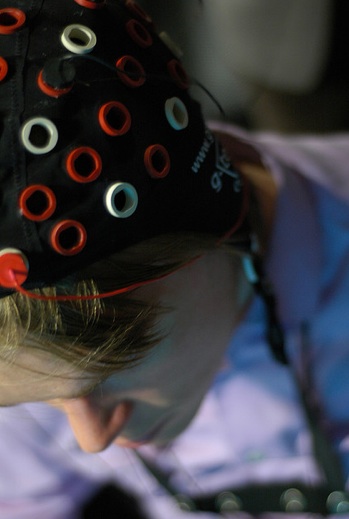
Yet another example of futuristic plotlines coming to fruition: New scientific research suggests that by stimulating parts of their brains electrically, people can be induced to think more creatively than they normally do.
Read more: Electric thinking cap? Flash of fresh insight by electrical brain stimulation
Subscribe to:
Posts (Atom)